Japanese 3017: A Modern Typeface Inspired by Hiragana and Kanji
What Makes Japanese 3017 Stand Out in Modern Typography
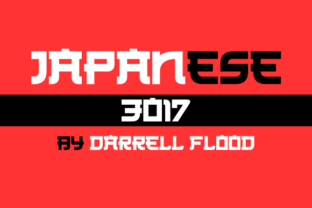
Every so often a typeface comes along that doesn't try to imitate tradition—it reinterprets it. Japanese 3017 is exactly that kind of creative font. Designed by Darrell Flood, this display font draws visual cues from Hiragana and Kanji characters, but it doesn't ask you to be a Japan specialist to use it effectively. The strokes are clean, deliberate, and built with readability front and center. That consistency in line weight and shape gives the font a grounded, almost meditative feel—something you don't always get from decorative typefaces.
From a designer's perspective, what makes Japanese 3017 refreshing is how it balances personality with restraint. The letterforms carry a handcrafted quality without feeling messy or overly stylized. Each character holds its own space. The stroke endings are crisp, the curves are controlled, and there's a subtle rhythm across the entire set. This isn't a font that screams for attention—it invites the viewer in. That makes it a strong contender for projects where you want cultural resonance without resorting to clichés.
Visual Personality and Style: What You're Actually Getting
Let's talk about what you'll see when you open Japanese 3017. The typeface sits somewhere between a handwritten font and a structured display font. It has the warmth of something drawn by hand, but the consistency of a carefully engineered typeface. The vertical and horizontal strokes feel intentional, almost like brushwork translated into digital form. You'll notice that the characters don't try to replicate actual Japanese script—instead, they evoke the essence of it. That's an important distinction for designers who want to use the font respectfully and creatively.
The overall personality is modern yet grounded. It's not overly ornate, which means it works well in both digital and print environments. Stroke consistency gives it a polished look even at larger sizes. At smaller sizes, the readability holds up surprisingly well for a display font, thanks to that clean stroke architecture. Whether you're working on logo design, editorial headers, or social media graphics, the font brings a distinct flavor that stands out without feeling gimmicky.
Brand Identity and Logo Design
If you're building a brand for a client in hospitality, fashion, wellness, or the creative arts, Japanese 3017 offers a unique anchor. The font carries enough personality to work as a standalone logotype, especially when paired with a clean sans serif or a minimalist serif for supporting text. Imagine a boutique tea brand using Japanese 3017 for its main mark, then pairing it with something like Inter or Lato for product descriptions. The contrast creates visual hierarchy immediately. The handwritten quality also makes the brand feel approachable and artisanal.
Editorial and Publishing
Magazine covers, feature article headers, and book chapter titles benefit from typefaces that feel intentional. Japanese 3017 works especially well in editorial design where you need a bold, distinctive title treatment. The stroke consistency helps maintain readability across spreads, and the cultural undertone adds depth without overwhelming the layout. I've seen it used effectively in travel publications, art monographs, and lifestyle magazines—it gives the page a sense of place and craft.
Packaging and Product Design
Packaging is all about shelf presence. Japanese 3017 can help a product tell its story at a glance. Think of a craft sake label, a skincare line with minimalist branding, or a specialty food product that wants to communicate quality and tradition. The font's clean lines reproduce well on various materials—paper, glass, metal, or digital mockups. For small business owners creating their own product lines, this commercial font offers a polished, premium look without requiring a full branding overhaul.
Web Design and Digital Content
Headers, hero sections, and call-to-action banners are natural homes for Japanese 3017 on the web. It pairs beautifully with neutral sans serif fonts for body text, creating a clean, modern hierarchy. The font's readability at medium sizes means you can even use it for short-form content like pull quotes or accent text. For social media graphics, it gives your posts a consistent, recognizable voice—especially useful for content creators and influencers who want their visual identity to feel curated.
Personal and Creative Projects
Don't underestimate the value of a creative font for personal work. Japanese 3017 works well for wedding invitations, art prints, journal covers, or even tattoo design concepts. Hobbyists and crafters will appreciate that the font can carry a project from concept to completion without needing a full type system. Sometimes you just need one good typeface to set the tone, and this one does that reliably.
How Japanese 3017 Influences Readability and Brand Perception
Readability in a display font isn't just about legibility—it's about how the text feels to read. Japanese 3017 achieves a calm, deliberate reading experience because the stroke weights are so consistent. There's no jarring contrast between thick and thin lines, which reduces visual fatigue in longer headers or repeated use. For brands, that translates into a perception of stability, care, and authenticity. When a font looks this intentional, the audience subconsciously trusts the message more.
Visual hierarchy also gets a boost. Because Japanese 3017 has such a distinct character, it naturally draws the eye when used as a header or accent. That reduces the need for heavy graphic elements to create contrast. You can let the type do the heavy lifting. For marketers and publishers, that means cleaner layouts and faster audience engagement. The font also works well in monochrome applications, so it's a strong choice for black-and-white print materials or minimalist brand systems.
Consistency across touchpoints is another hidden strength. When you use Japanese 3017 across your website, packaging, and social media, you create a cohesive visual thread. That builds recognition faster than switching between unrelated typefaces. For small business owners and entrepreneurs, this kind of consistency is pure gold—it makes a small operation look established and professional.
Evaluating Project Fit
Before committing to any commercial font, ask yourself what emotional tone you want your project to carry. Japanese 3017 lends itself to projects that value craftsmanship, warmth, and cultural subtlety. It's less suited for ultra-corporate, tech-forward, or industrial applications. If your brand voice is clinical or purely functional, this might not be the right fit. But if you're aiming for thoughtful, artisanal, or globally inspired, it's worth exploring.
Testing Font Pairings
Pairing is where Japanese 3017 really comes alive. Here are a few combinations worth testing:
- With a clean sans serif font like Open Sans or Montserrat for web and editorial layouts. The contrast between the handwritten Japanese influence and the geometric sans creates a modern, balanced look.
- With a classic serif font like Playfair Display for luxury or editorial projects. The serif adds structure while Japanese 3017 adds personality.
- With a subtle script font for invitations or personal branding—but use this sparingly to avoid competing styles.
- With a monospace font for a quirky, modern digital aesthetic that feels curated and intentional.
Reviewing Included Styles and Formats
Japanese 3017 comes as a single-weight display font, so understand its limitations upfront. It's not a full type family with multiple weights, italics, or extensive language support. That's fine for most header and accent applications, but you'll need a secondary font for body text. Check the included character set to make sure it covers the glyphs you need—especially if you're working with punctuation, numbers, or special characters for branding.
Readability Considerations
For longer text blocks, stick with your secondary font. Japanese 3017 is a display font at heart, and while it's remarkably readable for its category, it's not designed for paragraph-length content. Use it for titles, subtitles, quotes, and accent elements. At very small sizes, test it on your intended output medium—some of the finer stroke details may get lost in low-resolution digital displays or very small print.
Commercial Licensing
Japanese 3017 is a commercial font, so make sure you're using the appropriate license for your project. Whether you're a designer working for a client, a small business owner branding your own products, or a publisher using it in a magazine, check the terms from Darrell Flood's distribution. Licensing for web use, print runs, and digital products can differ. A proper license protects you and supports the type designer's work—something worth doing for quality design assets.
Real-World Observations and Recommendations
I've used Japanese 3017 in a few projects now, and one thing consistently surprises me: how often non-designers comment on it. There's something about the font's personality that resonates with people who don't normally notice typography. That's a good sign for brands trying to build recognition. It's also a font that photographs well in mockups and social media posts, which matters more than ever in a visual-first content landscape.
For bloggers and content creators, I recommend using Japanese 3017 in your hero images and video thumbnails consistently. Over time, that visual signature becomes part of your brand identity. For publishers, consider it for chapter openers or pull quotes—it adds a handcrafted touch that breaks up the monotony of standard text layouts. And for small business owners, don't be afraid to use it across your packaging and signage. A single, well-chosen typeface can elevate your entire visual presence without a complete redesign.
Japanese 3017 is a reminder that modern typography doesn't have to choose between cultural inspiration and practical readability. It's a premium font that earns its place in a well-considered design system—not because it's trendy, but because it works.
If you're exploring creative font options for your next project, give Japanese 3017 a test drive. Pair it, tweak it, and see how it changes the way your content feels. Sometimes the right typeface is all it takes to make a design go from good to memorable.