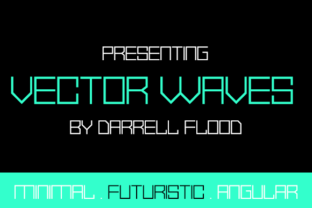
The Design Philosophy Behind Vector Waves: Why a Monoline Display Font Works for Modern Projects
Typography has a way of anchoring a visual identity. When you pick the right typeface, everything else falls into place. Lately, there has been a noticeable shift toward minimal, futuristic designs that prioritize clarity without sacrificing personality. This is where Vector Waves enters the conversation. Designed by Darrell Flood, this typeface walks a fine line between delicate refinement and bold presence. It is a monoline display font, which means every stroke carries the same thickness, giving it a clean, almost architectural feel. But what makes it worth adding to your toolkit? Let's break that down.
What Defines a Monoline Display Font Like Vector Waves
Monoline fonts are not new, but they have gained serious traction in recent years. The reason is simple: uniformity. When every line in every letter shares the same weight, the eye moves smoothly across the text. There are no abrupt thick-to-thin transitions to distract the viewer. Vector Waves takes this principle and pushes it toward a futuristic edge. The letterforms feel deliberate, almost as if they were drafted rather than drawn.
Display fonts, by nature, are meant to grab attention. They are not built for long paragraphs of body copy. Instead, they shine in headlines, logos, posters, and any context where typography carries the visual weight of the composition. Vector Waves fits this role naturally. Its minimal design does not compete with other elements. It coexists. And because the strokes are uniform, it pairs well with both serif and sans-serif body fonts without creating visual tension.
Darrell Flood designed this typeface with a specific sensibility in mind. It is not trying to be retro or nostalgic. It looks forward. The curves are smooth, the terminals are clean, and the overall impression is one of precision. If you work in branding, UI/UX, or any field where first impressions matter, this font offers a reliable way to communicate modernity without shouting.
Where Vector Waves Fits Into Modern Workflows
The real test of any typeface is whether it performs well across different mediums. Vector Waves holds up in digital environments because of its monoline structure. On screens, where resolution and pixel density vary, uniform stroke weight reduces the risk of thin parts disappearing or thick parts looking clunky. This makes it a strong candidate for app interfaces, landing page headers, and even motion graphics.
In print, the same principles apply. Whether you are working on a magazine cover, a product package, or a conference banner, the font maintains its integrity at various sizes. At large point sizes, the details become more apparent. The subtle curves and open counters give the typeface room to breathe. At smaller sizes, it remains legible as long as you use it for short bursts of text.
Consider a tech startup launching a new product. They want a logo that feels innovative but not gimmicky. Vector Waves offers exactly that balance. The minimal letterforms suggest efficiency and forward thinking. The monoline style implies precision. Combined with a strong color palette, the font can anchor an entire brand identity without needing elaborate illustrations or icons.
Another scenario is event branding. Imagine a conference about artificial intelligence or sustainable technology. The promotional materials need to convey sophistication and urgency. Using Vector Waves for the main title and a clean sans-serif for supporting text creates a hierarchy that feels intentional. The font does not imitate handwriting or historical styles. It stands on its own as a product of contemporary design thinking.
Practical Benefits of a Minimal, Futuristic Typeface
One of the underappreciated advantages of a font like Vector Waves is its versatility in color application. Because the strokes are uniform, gradient fills and outlines work exceptionally well. You can apply a metallic gradient to create a chrome effect, or use a neon color for a cyberpunk aesthetic. The font accepts these treatments without losing its shape or becoming unreadable.
Another benefit is the ease of pairing. When you use a highly decorative font, you often have to build the entire design around it. That can be limiting. With Vector Waves, the opposite is true. The typeface does not demand attention. It earns it. You can surround it with geometric shapes, abstract patterns, or photography, and it will hold its ground without dominating the composition.
From a technical standpoint, the font is optimized for display use. That means hinting and spacing are tuned for larger sizes. Kerning pairs are handled carefully so that letters sit well together. You will not see awkward gaps or tight clusters that break the flow of a word. This attention to detail is something Darrell Flood has prioritized, and it shows in how the font behaves across different software and rendering engines.
For designers who work with responsive layouts, Vector Waves also offers flexibility. Since the typeface is clean and uncluttered, it scales down reasonably well for mobile headers. You might not want to use it for body text, but for navigation labels, button text, or section headings, it works without issue. This reduces the need to switch fonts between breakpoints, simplifying your CSS or design system.
Characteristics That Set Vector Waves Apart
What makes Vector Waves distinct from other monoline display fonts? First, there is the subtle curvature. The font does not rely on rigid geometric forms. Instead, it introduces gentle arcs that soften the overall appearance. This prevents the typeface from feeling cold or mechanical, which is a common pitfall with minimalist designs.
Second, the x-height is relatively generous. This means lowercase letters appear larger in relation to uppercase ones. The result is a more approachable look. Even when you set a word in all caps, the proportions feel balanced. The ascenders and descenders are controlled, so text blocks maintain a consistent rhythm without erratic jumps.
Third, the font includes a set of characters that cover most European languages. If you work on international projects, you can rely on Vector Waves to handle accented characters and special punctuation without breaking the visual flow. This is not always a given with display fonts, which sometimes skimp on extended character sets.
Darrell Flood has also paid attention to the spacing around punctuation and numbers. In many fonts, numerals can feel cramped compared to letters. Here, the figures are given room to stand out, which is helpful for pricing tables, event dates, or data-heavy layouts. The uniformity of stroke weight extends to symbols as well, so an ampersand or percentage sign does not look out of place next to the rest of the text.
Recommendations for Using Vector Waves Effectively
If you decide to add Vector Waves to your font collection, here are a few practical ways to make the most of it:
- Pair with a neutral sans-serif like Helvetica Now, Inter, or Work Sans for body text. The contrast between a neutral body and a futuristic display font creates a clear hierarchy without clashing.
- Use it in all caps for maximum impact. Because the monoline structure is so consistent, all-caps settings look especially powerful. Try it for hero sections, taglines, or product names.
- Experiment with letter spacing. Adding a small amount of tracking can make the font feel even more modern. Just be careful not to overdo it, as too much space can break the connection between letters.
- Apply it to physical products like merchandise packaging or apparel. The clean lines translate well to embroidery, foil stamping, or screen printing. The minimal design ensures it works at small scales on labels or tags.
- Combine with geometric illustrations or iconography. The font shares a similar visual language with simple shapes and line art. A layout that uses circles, lines, and Vector Waves feels cohesive and intentional.
One thing to keep in mind is legibility at extremely small sizes. While the font works well for headings and short lines, it is not suited for captions or footnotes. Reserve it for the parts of your design that need to make a statement. Let other fonts handle the heavy lifting of extended reading.
Why Designers Keep Returning to Futuristic Display Fonts
Trends come and go, but the demand for forward-looking typography remains steady. As technology evolves, so do visual expectations. People associate clean, minimal fonts with innovation. Brands that want to appear current often invest in typefaces that look like they belong in a sci-fi interface or a modern art gallery. Vector Waves satisfies that need without feeling derivative.
It also helps that Darrell Flood has created a font that respects the fundamentals of typography while pushing into new territory. The letters are not overly stylized. They do not rely on unusual angles or exaggerated proportions. Instead, they achieve their futuristic feel through restraint. That is a harder thing to pull off than it sounds. Many typefaces that aim for a modern look end up feeling dated within a few years. Vector Waves avoids that by staying grounded in timeless principles: balance, clarity, and consistency.
For anyone building a design system or updating a brand identity, this font offers a reliable option that will not look out of place in five or ten years. It is not chasing a short-lived trend. It is establishing a visual language that can evolve with the project.
Final Observations on Vector Waves by Darrell Flood
When you evaluate a typeface, you have to consider not just how it looks in a specimen sheet, but how it performs in real-world conditions. Vector Waves does well on both fronts. It presents beautifully in mockups and renders, and it holds up under the constraints of actual design work. Whether you are crafting a logo, building a website, or designing print materials, this font gives you a solid foundation to work from.
The monoline structure, the minimal aesthetic, and the futuristic undertones make it a versatile addition to any designer's library. It does not try to be everything to everyone. Instead, it excels in the specific role it was designed for: a display typeface that communicates clarity and innovation. If you have been looking for a font that balances delicacy with boldness, one that feels both current and lasting, then Vector Waves is worth considering.
Darrell Flood has put thought into every character, and that level of craftsmanship is what separates a good font from a great one. Add it to your collection, experiment with it, and see how it transforms your next project.