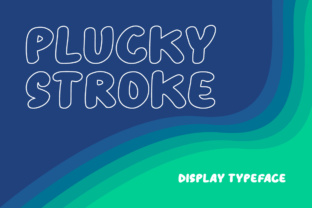
Plucky Stroke: A Modern Outline Display Font for Creative Design
In the ever-expanding universe of typography, designers are constantly searching for typefaces that combine personality with versatility. Among the many styles available, outline fonts hold a special place for their ability to convey lightness, openness, and a touch of whimsy. One such typeface that has been gaining attention is Plucky Stroke. But what exactly is this font, and why is it becoming a go-to choice for creatives? This article will take you from the basics to the practical applications, helping you understand how Plucky Stroke can elevate your design projects.
What Exactly is Plucky Stroke?
At its core, Plucky Stroke is a modern outline display font. Unlike standard text fonts designed for long reading passages, display fonts are crafted to make a statement. They are used for headlines, logos, posters, and any situation where the visual impact of the letterform is as important as the words themselves.
The "outline" characteristic means that the letters are defined by their contours rather than a filled interior. Think of it like a coloring book page: the shape is created by the line that surrounds the letter, leaving the center empty or transparent. Plucky Stroke takes this concept and gives it a contemporary twist. Its letterforms are clean, geometric, and characterized by rounded corners and consistent stroke widths, giving it a friendly, approachable feel while maintaining a modern, minimalist aesthetic.
The name "Plucky" suggests a sense of spirited determination, and the font lives up to this by feeling energetic yet controlled. It is neither overly decorative nor purely functional; it strikes a balance that makes it suitable for a wide range of creative uses.
The Unique Characteristics of Plucky Stroke
What sets Plucky Stroke apart from other outline fonts? A few key features contribute to its distinct personality and utility:
- Geometric Structure: The font is built on geometric shapes—circles, straight lines, and uniform curves. This gives it a sense of order and modernity, reminiscent of mid-century design but with a fresh, digital-age polish.
- Rounded Terminals: The ends of strokes, where letters like 'a', 'c', or 's' finish, are softly rounded. This softens the geometric rigidity and adds a touch of warmth and playfulness.
- Consistent Stroke Weight: The thickness of the outline is uniform across all characters. This consistency ensures readability at various sizes and creates a harmonious visual rhythm.
- Open Counters: The interior spaces of letters (counters) are generous and fully open. This enhances legibility and reinforces the airy, light feel of the font.
- Modern Minimalism: There are no extra flourishes, serifs, or decorative elements. The beauty lies in the simplicity of the outline form itself.
These characteristics make Plucky Stroke not just a font, but a design tool that can be used to create visual interest without overwhelming the viewer.
Why Use an Outline Display Font? Purpose and Significance
You might wonder: why choose an outline font when solid fonts are the default? The answer lies in the unique visual properties of outlined letters. A filled font is solid and heavy; it commands attention by occupying space. An outline font, by contrast, is light and transparent. It suggests form without filling it in, creating a sense of airiness, modernity, and sophistication.
Outline fonts like Plucky Stroke are particularly effective for:
- Layering: You can place an outline font over a background image, texture, or pattern, and the content behind the text remains partially visible. This creates depth and complexity.
- Duotone and Gradient Effects: Because the letters are open, you can fill the interior with a different color or gradient, creating striking visual contrast.
- Subtle Branding: In situations where a solid font might feel too heavy or domineering, an outline font can provide a lighter, more elegant touch.
- Modern Aesthetics: Outline fonts are strongly associated with contemporary, minimalist, and digital-native design. They feel current and fresh.
In a world where visual clutter is common, the restraint of an outline font can be a powerful tool. Plucky Stroke, with its clean lines and rounded warmth, embodies this principle perfectly.
Clarifying a Common Misunderstanding
Some people assume outline fonts are only for decorative or "artsy" projects and are difficult to read. While it's true that overly ornate outline fonts can sacrifice legibility, Plucky Stroke is designed with clarity in mind. Its geometric structure and consistent stroke width mean that even at smaller sizes, the letters remain recognizable. It is a functional display font, not a gratuitous novelty. The key is to use it in contexts where its transparent nature adds value—typically for short text blocks, headlines, or key brand elements.
Practical Applications of Plucky Stroke in Modern Design
Plucky Stroke's versatility makes it suitable for a wide range of industries and media. Here are some real-world scenarios where this font shines:
Branding and Logo Design
For brands that want to project a modern, approachable, and innovative image, Plucky Stroke can be an excellent choice for a wordmark or logo. Its rounded geometry feels friendly and accessible, while the outline form suggests openness and transparency—values that resonate with many contemporary businesses, especially in tech, creative services, and lifestyle sectors. A logo using Plucky Stroke can be particularly effective when paired with a solid, complementary typeface for taglines or secondary text.
Posters and Print Media
In posters, flyers, and event announcements, Plucky Stroke's lightness allows it to sit beautifully over photographs or colorful backgrounds. Imagine a music festival poster with a vibrant photo of a stage: Plucky Stroke in white overlaying the image creates a clean, ethereal headline that doesn't block the visual. It works equally well for minimalist posters where the text itself becomes the main visual element.
Digital and Web Design
On screens, Plucky Stroke is a natural fit for hero section headlines, navigation headers, or call-to-action buttons. Its open nature makes it ideal for hover states or animated effects—for example, filling the interior of the letters with a color on mouseover. Because digital design often values space and clarity, the airiness of an outline font helps content feel less crowded. Plucky Stroke is also a popular choice for social media graphics, where standing out in a busy feed is essential.
Packaging and Product Design
In packaging, Plucky Stroke can bring a sense of premium minimalism. It works well for cosmetic products, specialty foods, or artisanal goods where the packaging is clean and the focus is on the product. An outline font can be embossed, debossed, or printed with a foil finish for a tactile, high-end feel. The transparency of the letters can also allow the product's color or texture to show through, creating an integrated design.
How Plucky Stroke Fits into Modern Creative Workflows
Typography in 2025 is more fluid and interconnected than ever. Designers are using fonts across multiple platforms—from print to web to motion graphics. Plucky Stroke is typically available in a range of weights (some versions include Light, Regular, Bold, etc.), giving designers flexibility within the same family. Its geometric consistency also makes it relatively straightforward to pair with other typefaces. Some natural companions include:
- Sans-serif solid fonts like Montserrat, Futura, or Helvetica for body text (the solid font anchors the design while Plucky Stroke adds the accent).
- Script fonts for a contrast between structure and flow (use sparingly for emphasis).
- Monospace fonts for a tech-forward, industrial contrast.
In motion design, Plucky Stroke's outline form is particularly useful. You can animate the stroke itself—creating a "drawing" effect where the line appears sequentially—or you can fill the letters with gradients, patterns, or even video footage. This makes it a favorite for title sequences, explainer videos, and Instagram stories.
Common Misunderstandings About Outline Fonts
Beyond the legibility concern mentioned earlier, there are other assumptions worth addressing. One is that outline fonts are only for "modern" or "minimalist" contexts. While Plucky Stroke does lean modern, its rounded warmth means it can also work in more playful or casual settings—think children's books, craft fairs, or friendly app interfaces. Another misconception is that you must always fill outline fonts with color. In fact, leaving them as pure outlines over a contrasting background is often the most striking use. The negative space inside the letters becomes part of the design.
Tips for Using Plucky Stroke Effectively
To get the most out of Plucky Stroke, consider these practical guidelines:
- Use it for short text. Outline fonts are generally less readable in long paragraphs. Reserve Plucky Stroke for headlines, key words, or short phrases.
- Pair it with a solid font. Create contrast by using Plucky Stroke for the headline and a clean, solid sans-serif for body text. This balanced hierarchy improves readability and visual interest.
- Mind the background. Because the letters are transparent, the background plays a crucial role. Ensure sufficient contrast—typically a light font on a dark background or vice versa. Plucky Stroke works beautifully over textures, gradients, and images, but test legibility at various sizes.
- Experiment with fills and effects. Try applying a gradient to the interior of the letters, or use a duotone effect with two contrasting colors. In digital design, consider adding a subtle shadow or glow to make the outline pop.
- Scale appropriately. Plucky Stroke is a display font, so use it at larger sizes (typically 24pt or higher for print, or 30px or higher for screen). At very small sizes, the thin stroke may become hard to see.
Conclusion: Embracing the Plucky Stroke
Plucky Stroke represents a thoughtful evolution of the outline display font. By combining geometric precision with rounded warmth, it offers designers a tool that is both modern and inviting. Its purpose goes beyond decoration: it brings a sense of openness, lightness, and clarity to any project. Whether you are designing a brand identity, a poster, a website, or a product package, Plucky Stroke can help you communicate with confidence and style.
As with any typeface, the key is understanding its strengths and using it with intention. Plucky Stroke is not a font for everything, but in the right context—short, impactful text that benefits from a transparent, geometric form—it can be truly plucky in the best sense: spirited, bold, and full of character. The next time you need a font that stands out without overwhelming, consider giving Plucky Stroke a try. Its clean contours and modern sensibility might be exactly what your design needs to feel fresh and current.