The Art of Imperfection: Why a Scandinavian Kids Font Captures Authentic Design
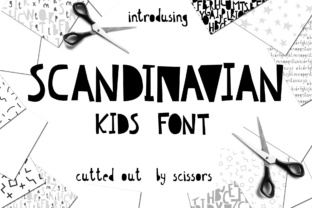
In a digital landscape dominated by sleek, machine-perfect typefaces, there is a quiet revolution happening in the world of typography—one that embraces the charm of asymmetry, the warmth of handmade lettering, and the bold simplicity of monochrome aesthetics. A Scandinavian kids font offers something genuinely different: it is not merely a set of characters, but a deliberate artifact of childhood creativity. Each letter, as the concept suggests, has been carefully cut out from a piece of paper by a child, preserving the organic wobble, uneven curves, and playful proportions that no algorithm can replicate. The result is a typeface that feels less like a design tool and more like a tangible memory—a piece of artwork that brings Scandinavian minimalism into contact with the raw, unfiltered energy of a young hand at work.
What makes this font distinctive is not just its origin story, but how it manages to bridge two seemingly opposite worlds: the disciplined, monochrome design heritage of Scandinavia and the unpredictable, expressive nature of a child's motor skills. The font includes main uppercase letters, alternative uppercase forms, uppercase double letters, and a full set of lowercase characters. Each variation carries its own personality, yet they all share a common thread—an honesty that is often missing from polished digital type. The Scandinavian kids font does not try to hide its imperfections; it celebrates them. And that is precisely why it resonates with educators, designers, hobbyists, and business owners who want their communication to feel human again.
The Story Behind the Cutouts
Understanding the origin of this Scandinavian kids font means stepping into a classroom, a kitchen table, or a quiet afternoon where a child holds a pair of scissors and a sheet of black or white paper. There is no digital tablet involved, no bezier curves, no undo button. The child cuts slowly, sometimes hesitantly, and each snip produces a letter that is unique. The A might be slightly lopsided, the O might not close perfectly, and the strokes of an uppercase M may vary in thickness. These are not mistakes—they are signatures of a process that prioritizes exploration over precision.
The designer behind this typeface took those paper cutouts, scanned them with care, and converted them into a digital format without stripping away their tactile character. The rough edges remain. The slight deviations from straight lines are preserved. The spacing between letters, even when adjusted for readability, still carries the memory of a child's spatial judgment. This gives the font an authenticity that is extremely hard to manufacture artificially. In an era where generative AI can create thousands of fonts in seconds, a Scandinavian kids font stands out because it is rooted in a real, physical act of creation. It tells a story before a single word is typeset.
The choice of monochrome—black on white or white on black—is a deliberate nod to Scandinavian design sensibilities. Clean, high-contrast, and devoid of decorative clutter, the monochrome palette ensures that the character of the cutout letters takes center stage. There are no gradients, no shadows, no embellishments. The font relies entirely on the shape and texture of the paper-cut forms. This restraint is what makes the typeface versatile. It can appear on a poster, a children's book cover, a branding identity, or a classroom worksheet without feeling out of place. The monochrome treatment also makes it highly legible at larger sizes, where the paper-cut texture becomes a visual feature in itself.
Monochrome Aesthetics and Childhood Expression
The marriage of Scandinavian monochrome design with a child's handmade lettering is not an obvious one. Scandinavian design is often associated with minimalism, functionality, and a certain cool precision—think of Arne Jacobsen's chairs or the clean lines of modern Stockholm architecture. Childhood expression, on the other hand, is messy, spontaneous, and emotionally driven. Yet, when these two forces come together in a Scandinavian kids font, the result is neither chaotic nor cold. Instead, it achieves a rare balance where structure provides a frame, and imperfection provides the soul.
Consider the alternative uppercase letters included in the font. A child might cut the same letter several times, each version slightly different. The alternative set captures this variation, allowing designers to switch between subtly different forms of the same character within a single word or headline. This creates a handmade rhythm that feels organic rather than repetitive. It mimics the way a real child would write or cut—each instance a fresh attempt, never identical. For a brand or a project that wants to communicate authenticity, creativity, or a human-centered approach, this kind of typographic texture is invaluable.
The uppercase double letters are another thoughtful inclusion. In Scandinavian languages, double letters appear frequently—aa, ee, ll, tt, and so on. Having dedicated double-letter cutouts means that the spacing and visual weight of repeated characters look natural, rather than appearing like two separate letters placed side by side. This level of detail shows that the font was not designed in a vacuum; it was crafted with real linguistic use in mind. The lowercase set, meanwhile, completes the functional range, making the font suitable for longer texts, captions, and educational materials where both uppercase and lowercase forms are needed.
From a design perspective, the monochrome constraint forces the font to communicate purely through shape. There is no color to distract the eye. The contrast between black and white heightens the visibility of every cut mark, every uneven curve, every subtle asymmetry. This makes the Scandinavian kids font especially effective in contexts where visual clarity and emotional warmth need to coexist. A classroom alphabet poster, for example, benefits from the high contrast for readability, while the hand-cut quality invites children to connect with the letters as something made by someone like them.
Understanding the Font's Character Set
When exploring what this Scandinavian kids font includes, it is helpful to break down the components in a practical way. The character set is structured to offer flexibility while maintaining a cohesive handmade look. Here is what users can typically expect:
- Main uppercase letters: The primary set of capital letters, each with a distinctive paper-cut appearance. These form the backbone of the font and are suitable for headings, titles, and emphasis.
- Alternative uppercase letters: Additional versions of several uppercase characters that offer different cutting styles, angles, or proportions. These allow designers to mix and match for a more varied, organic look.
- Uppercase double letters: Pre-combined pairs of identical uppercase letters, designed to maintain natural spacing and visual flow. Particularly useful for Scandinavian languages and any text requiring repeated capitals.
- Lowercase letters: A full set of minuscule characters that retain the same hand-cut quality as the uppercase set, making the font viable for sentence-level text and educational content.
One of the considerations when working with a Scandinavian kids font is that the irregular shapes can affect readability at very small sizes. The rough edges and uneven strokes that make the font so charming at 36 points may become indistinct at 10 points. This is not a flaw, but a design characteristic that informs how the font should be used. For large headlines, display text, posters, book covers, and signage, the font excels. For long body text in small sizes, a more neutral companion font may be preferable. The key is to use the Scandinavian kids font where its texture and personality can be fully appreciated—at sizes and in contexts where the hand-cut detail remains visible.
Real-World Applications Across Different Fields
The versatility of a Scandinavian kids font extends far beyond typical children's media. While it is certainly at home in picture books, nursery decor, and kindergarten materials, its design qualities make it suitable for a much broader range of uses. Business owners looking to create a brand identity that feels approachable and authentic can use the font in logos, packaging, or social media graphics. A café that emphasizes organic ingredients and handmade goods, for example, might find that the font's paper-cut aesthetic aligns perfectly with its brand values. The monochrome palette ensures that it integrates smoothly into existing design systems without introducing visual noise.
For educators and researchers, the font can serve as a tool for literacy development. Because the letters look like something a child might produce themselves, young learners often feel a sense of familiarity and encouragement when they see it. An alphabet chart printed in this Scandinavian kids font can help reduce the intimidation factor of formal typography, making letters feel more approachable. Researchers studying early handwriting or the psychology of typography in learning environments might also find the font useful as a stimulus that bridges the gap between child-produced and professionally designed materials.
Hobbyists and creators—scrapbookers, card makers, content creators, and crafters—can use the font to add a tactile, handmade dimension to digital projects. A birthday invitation, a poster for a local event, or a YouTube thumbnail all benefit from the warmth and personality that this font brings. Because it is digital, it can be scaled, colored, and layered with other design elements, while still retaining the authentic cutout texture that makes it unique. The alternative uppercase letters enable creative mixing that keeps each project feeling fresh and custom-made.
Designers and creative professionals may appreciate the font as a counterbalance to the sterile perfection of many modern typefaces. Using a Scandinavian kids font in a layout intentionally introduces an element of surprise and humanity. It works well in combination with clean sans-serif or serif fonts, creating a contrast between polished and raw, digital and analog. In editorial design, a drop cap set in the Scandinavian kids font can draw the eye and set a playful tone for an article. In branding, it can signal that a company values creativity, authenticity, and a personal touch over corporate uniformity.
What Educators and Designers Should Consider
While the appeal of a Scandinavian kids font is broad, there are practical considerations that educators and designers should keep in mind to use it effectively. For educators, the font's legibility in classroom materials depends largely on the age group and the context. For very young children who are still learning letter shapes, the font's irregularities might be confusing if used for tracing or handwriting models. In such cases, the font is better suited for decorative displays, motivational posters, or labels rather than instructional worksheets. For older children, the font can serve as a creative prompt—showing them that letters can be art, and that imperfection is a valid expressive choice.
Designers should pay attention to spacing and kerning when using the font. Because the letters are based on paper cutouts, their side bearings may be less consistent than in professionally spaced typefaces. Manual kerning adjustments, especially in headlines and logos, can make a significant difference in readability and visual balance. Additionally, the font works best on backgrounds that complement its monochrome origin—solid colors, subtle textures, or photographic images with high contrast. Busy backgrounds can obscure the delicate edges of the cutout shapes, diminishing the very quality that makes the font special.
Another consideration is the emotional tone the font projects. The Scandinavian kids font is inherently playful, sincere, and slightly nostalgic. It may not be appropriate for formal legal documents, financial reports, or medical communications where authoritative tone is critical. However, for internal communications, community announcements, school newsletters, or creative briefs, it can add a layer of warmth that fosters connection. Understanding the font's voice is essential to deploying it in the right context.
From a technical standpoint, users should verify that the font file includes the character sets they need—particularly the alternative uppercase and double-letter forms, as these are not always present in standard typeface implementations. Some versions of the font may also include punctuation, numerals, and basic symbols rendered in the same paper-cut style, which can extend its usefulness for complete typographic projects. Checking the font's licensing for commercial use is also important, as some handmade fonts have restrictions that differ from mainstream typefaces.
Bringing Scandinavian Simplicity to Digital Projects
In a practical sense, integrating a Scandinavian kids font into a project is straightforward, but achieving the best results requires thoughtfulness. Start by identifying the key message and the audience. A font that evokes childhood and Scandinavian design simultaneously works wonderfully for projects centered on learning, creativity, family, community, or handmade quality. The monochrome nature of the font makes it an excellent candidate for minimalist layouts where visual clutter is minimized. Pair it with ample white space, geometric shapes, and natural materials in supporting graphics to reinforce the Scandinavian aesthetic.
Experiment with scale. The hand-cut details become more pronounced at larger sizes, making the font ideal for hero headlines, pull quotes, and large-form prints. At smaller sizes, use the font sparingly—perhaps for single words or short phrases—to maintain its impact. The alternative uppercase letters are particularly useful for creating variation in all-cap headlines, preventing the monotony that can occur with repeated identical characters. The uppercase double letters can be used to add a distinctive Scandinavian touch to place names, brand names, or any text that features repeated capitals.
Combining the Scandinavian kids font with other typefaces requires a deliberate approach. A clean, neutral sans-serif like Helvetica Neue or Gotham provides a strong contrast to the irregular handmade forms. A classic serif like Garamond or Georgia can create a more traditional yet playful juxtaposition. The key is to let the Scandinavian kids font be the voice of emotion and personality, while the supporting font handles readability and structure. This division of labor allows each typeface to do what it does best, resulting in a harmonious and effective design.
For digital interfaces—websites, apps, presentations—the font can be used for headings, navigation accents, or hero section text. Because it is a display font, it should be reserved for elements where visual impact is the primary goal. Body text in digital interfaces typically requires higher legibility at small sizes, so a complementary font is recommended for paragraphs. However, a single word or short phrase set in the Scandinavian kids font within an interface can create a memorable brand touchpoint that users respond to emotionally.
The rise of handmade and imperfect typography in recent years reflects a broader cultural shift toward valuing authenticity over perfection. People are tired of sterile, corporate visuals that feel disconnected from human experience. A Scandinavian kids font taps directly into this sentiment by offering something that is simultaneously simple, crafted, and deeply personal. It reminds us that design does not have to be flawless to be beautiful—and that sometimes, the most powerful tool in a designer's kit is a willingness to let imperfection speak.
Whether you are an educator designing a classroom environment that inspires, a business owner building a brand that feels approachable, a researcher studying the intersection of typography and development, or a hobbyist creating something for the joy of it, this typeface offers a unique way to communicate. It carries within it the memory of a child's hand, the discipline of Scandinavian aesthetics, and the endless possibility of paper and scissors. That combination is rare, and it is worth exploring—one cutout letter at a time.