Operation 22: A Handcrafted Font Worth Your Attention
Typography choices can make or break a project. Whether you are designing a brand identity, crafting a website, or laying out print materials, the right typeface sets the tone before anyone reads a single word. Operation 22, a handcrafted font created by Creativeqube, enters this space with a distinct personality. But like any design tool, it carries specific strengths and tradeoffs worth examining before you commit.
What Makes Operation 22 Distinct
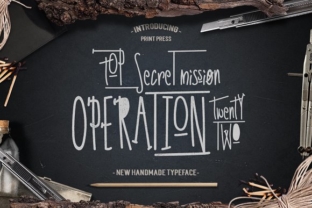
Operation 22 belongs to the category of handcrafted display fonts. Unlike mass-produced typefaces that aim for mechanical perfection, this font embraces the irregularities that come from manual creation. Each character carries slight variations in stroke weight, curve, and spacing — characteristics that are intentional rather than accidental. Creativeqube designed it with a deliberate sense of imperfection that gives text a human, tactile quality.
The font draws inspiration from mid-century signage and vintage typography, but it does not simply replicate those styles. Instead, it blends retro influences with contemporary clarity. Letterforms tend to be bold and assertive, with pronounced serifs or thick strokes depending on the weight you choose. This makes Operation 22 particularly effective at larger sizes where its details become visible and impactful.
One technical aspect worth noting is the font's kerning and spacing. Because it is handcrafted, the spacing between individual letter pairs may not follow the uniform metrics found in standard system fonts. This is not a flaw — it is part of the character — but it does require attention when setting text, especially at smaller sizes or in tight layouts.
Comparing Operation 22 with Other Handcrafted Options
If you are evaluating Operation 22, you are likely also considering other hand-drawn or artisan typefaces. The handcrafted font market has grown significantly in recent years, with many designers releasing their own interpretations of imperfect, organic lettering. Understanding where Operation 22 fits within this landscape helps clarify whether it matches your needs.
Many handcrafted fonts lean heavily into roughness — distressed edges, irregular baselines, and exaggerated quirks that scream "handmade." Operation 22 takes a more restrained approach. Its irregularities are subtle enough that the font remains legible and professional, yet present enough to avoid feeling sterile. This balance puts it in a middle ground between purely decorative script fonts and more conventional serif or sans-serif families.
Compared to fonts that simulate brush strokes or chalk textures, Operation 22 feels more like ink on paper — clean but not sterile, crafted but not chaotic. It works well for projects where you want authenticity without sacrificing readability. This makes it a strong candidate for logos, headlines, posters, and packaging where the text needs to stand out without overwhelming the message.
Strengths That Set Operation 22 Apart
Several qualities make Operation 22 worth considering over other handcrafted options:
- Versatility across contexts. Many handcrafted fonts look fantastic in one setting but fall apart in another. Operation 22 holds up reasonably well across print and digital applications, provided you use it at appropriate sizes. Its bold weights work for headlines, while lighter versions or careful spacing can handle shorter body text segments.
- Distinct character without being distracting. The font adds personality to any text, but it does not force the reader to work harder to understand the message. This is a common tradeoff with highly decorative fonts — they grab attention but sacrifice clarity. Operation 22 navigates this tension better than many alternatives.
- Branding potential. For businesses or individuals looking to establish a visual identity that feels approachable and authentic, this font offers a strong foundation. It pairs well with neutral sans-serif typefaces for a complementary contrast — a classic strategy in professional branding.
- Creativeqube's craftsmanship. The foundry behind Operation 22 has put noticeable care into the font's details. Character consistency, available glyphs, and overall polish reflect a designer who understands both aesthetics and functionality. This is not a quick digitalization of a sketch, but a refined product.
Tradeoffs and Limitations to Consider
No font works everywhere, and Operation 22 has boundaries you should acknowledge before selecting it for a project.
Size sensitivity. This font performs best at larger point sizes — typically 24 points and above. At smaller sizes, especially below 14 points, the handcrafted details begin to blur together. Letters can appear cramped or uneven, and the very qualities that make the font appealing at scale become liabilities in fine print. If your project requires extensive body text at standard reading sizes, you will likely need a complementary typeface for those portions.
Limited weight and style range. Operation 22 is not an extensive type family. You may find only a handful of weights — regular, bold, perhaps an italic or outline version. This contrasts with large type families that offer dozens of variations for maximum flexibility. If your project demands fine-grained typographic hierarchy across many levels, you may need to pair Operation 22 with another font for secondary and tertiary text.
Character set coverage. As a specialty display font, Operation 22 may not include extensive multilingual support, extended punctuation, or specialized symbols. Always check the available glyphs before committing, especially if your content includes accented characters, unique punctuation, or non-standard typographic elements.
Pairing requirements. Operation 22 has a strong voice. That voice can clash with fonts that are equally assertive. Finding complementary typefaces takes more effort than with neutral fonts. Sans-serif fonts with clean lines and moderate proportions tend to work best as companions, but you will need to test combinations in your actual layouts rather than relying on general rules.
When Operation 22 Is the Right Choice
Based on its characteristics, Operation 22 suits several specific scenarios particularly well:
- Branding for small businesses or creative professionals. If you want a logo or brand mark that feels personal and crafted, this font communicates that without looking like a trend-driven choice that will age poorly.
- Posters, flyers, and event materials. Large-format designs benefit from the font's bold character and visible handcrafted details. Concert posters, workshop announcements, or product launches are natural fits.
- Packaging for artisanal or boutique products. Products that emphasize handmade quality, local production, or traditional methods align well with the font's aesthetic. Coffee packaging, craft beer labels, or small-batch food products are common examples.
- Short-form digital content. Social media graphics, YouTube thumbnails, or website hero headers can use Operation 22 to grab attention quickly. Keep text brief — a few words or a short phrase — and let the font do the work.
When You May Need Another Option
There are also clear situations where Operation 22 is likely not the best fit:
- Long-form body text. Anything beyond a paragraph of continuous reading at standard sizes will strain the font's readability. Choose a conventional serif or sans-serif for body copy and reserve Operation 22 for headings.
- Corporate or formal communications. Law firms, financial institutions, or government agencies typically need neutral, highly legible typefaces that convey authority and precision. Operation 22's handmade character may feel too informal for these contexts.
- Multilingual projects with complex character needs. If your content uses Cyrillic, Greek, Arabic, or extensive diacritics, verify coverage before purchasing. Many display fonts prioritize Latin character sets.
- Projects requiring strict typographic hierarchy. If you need six or seven distinct text levels — from main headline to footnotes — a single display font with limited weights will struggle to provide enough contrast across levels.
Practical Considerations Before Choosing
Before you decide on Operation 22, take a moment to evaluate your project through a few practical lenses:
- Test at actual usage sizes. Do not judge the font based on preview images at large sizes. Download a trial version if available, or use the foundry's test drive feature, and set your actual text at the sizes you plan to use.
- Consider your pairing strategy. Identify a complementary font early in your process. Test combinations together in mockups rather than in isolation. A font pairing that looks good in theory may fail in practice.
- Check license terms. Creativeqube's licensing may vary between personal and commercial use. Confirm that your intended use — whether for a client project, a product you sell, or a digital platform — is covered by the license you purchase.
- Think about long-term use. If you are choosing a font for a brand or ongoing project, consider whether its style will remain appropriate as your project evolves. Trend-driven typefaces can date quickly, but Operation 22's mid-century inspiration gives it a more timeless foundation than many alternatives.
Making an Informed Decision
Operation 22 occupies a thoughtful place in the handcrafted font landscape. It offers genuine character without the excessive roughness that limits many similar fonts to narrow use cases. Its strengths — authenticity, visual impact at larger sizes, and branding potential — make it a strong candidate for projects that benefit from a human touch.
At the same time, its limitations around size sensitivity, character coverage, and weight variety mean it is rarely a standalone solution. The most successful uses of Operation 22 treat it as a specialized tool within a larger typographic system, not as a universal typeface.
When you compare it to other handcrafted options, ask yourself what you need most: Is it raw, unpolished authenticity? Or is it a crafted balance between handmade warmth and professional readability? Operation 22 leans toward the latter. If that aligns with your project's goals, it deserves a serious look. If you need something more rugged or something more neutral, other options may serve you better.
Ultimately, the best typeface is the one that fits your content, your audience, and your context. Operation 22 fits a specific set of those conditions well. By understanding both what it offers and where its boundaries lie, you can make a choice that strengthens your work rather than complicating it.