Tokyo 2097: Where Angular Momentum Meets Cyberpunk Typography
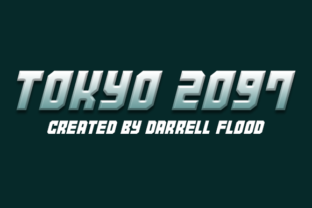
In the vast landscape of modern type design, few creations capture the essence of forward motion as sharply as Tokyo 2097. Designed by Darrell Flood, this angular, directional font does not simply sit on a page — it propels the eye forward, carving a visual path that feels both futuristic and grounded in the kinetic energy of a city that never stops. Unlike many decorative typefaces that prioritize aesthetic shock over readability, Tokyo 2097 balances structural precision with a sense of velocity that makes it stand out in an overcrowded digital typography market.
The Design DNA of Tokyo 2097
At first glance, Tokyo 2097 announces itself through sharp, slanted terminals and deliberate geometric compression. Every letterform is constructed with angled cuts and asymmetrical counters that suggest constant movement. Darrell Flood approached this typeface not as a static set of characters but as a system of visual trajectories. The lowercase t, for instance, leans into its ascender with a sheared top that resembles a blade slicing through air. The uppercase N widens at its base, creating an almost architectural stability that prevents the overall design from feeling unstable.
The angularity is not arbitrary. Each vertex and intersection follows a consistent logic of directional push — stroke endings point roughly toward the upper right quadrant, as if the entire alphabet is leaning into a wind generated by speed. This gives Tokyo 2097 what designers often call optical momentum, a quality that makes headlines and short-form text feel urgent without resorting to bold weight or aggressive kerning.
Structural Precision in Every Character
What separates Tokyo 2097 from other angular typefaces is its insistence on readability despite radical geometry. Many fonts that embrace extreme angles sacrifice legibility at smaller sizes, but Flood engineered this typeface with careful attention to counter shapes — the negative spaces inside letters like e, a, and g. These openings remain wide enough to be distinguishable at body text sizes, even as the outer contours cleave aggressively. The result is a typeface that works in posters and motion titles while also holding its own in UI labels and short paragraphs.
The weight distribution across characters is also notable. Descenders are trimmed but not eliminated, and the baseline remains stable despite the angled ascenders. This prevents the visual instability that plagues many high-angle fonts, where every line of text appears to slide downhill. Tokyo 2097 plants its feet while leaning forward — a subtle but critical engineering choice.
Applications Across Media and Industries
The practical uses of Tokyo 2097 extend far beyond typical cyberpunk aesthetics. While its name and visual language evoke a neon-lit future, the typeface finds surprising relevance in contexts that demand attention, direction, or a break from conventional typographic neutrality.
Digital Interfaces and Motion Design
In UI design, where micro-interactions and transitions define user experience, Tokyo 2097 excels as a display typeface for navigation headers, call-to-action buttons, and loading state animations. The angular cuts naturally complement slide-in transitions and parallax scrolling effects. Designers working with WebGL or Canvas-based applications often pair it with particle systems and gradient overlays, where the font's directional thrust aligns with animated elements moving across the screen.
Motion designers particularly value how Tokyo 2097 behaves under transformation. Scale shifts, skew operations, and rotation animations all feel organic because the typeface already contains built-in directional tension. A title that scales up and sharpens its angle during a transition sequence looks intentional rather than distorted. This makes the font a favorite for title sequences, game UI overlays, and augmented reality interfaces where typography must coexist with moving 3D elements.
Brand Identity and Logos
Startups in the mobility, logistics, and automotive technology sectors have adopted Tokyo 2097 for logotype treatments because its angular character suggests speed, precision, and forward thinking. A logistics dashboard using this font communicates efficiency before a single data point is read. Similarly, esports teams and gaming hardware brands leverage its aggressive stance to signal competitiveness and technological edge.
However, the font is not limited to heavy industries. Boutique fitness studios, especially those focused on high-intensity interval training or cycling, use Tokyo 2097 in marketing materials to evoke energy and movement. A studio name set in this typeface at the top of a schedule poster immediately conveys the intensity of the workout, without needing additional graphic elements.
Print and Editorial Design
In print, Tokyo 2097 shines in magazine spreads about urban culture, architecture, automotive design, and technology. Its angular nature complements architectural photography with strong diagonal lines, and it pairs well with sans-serif body fonts like Inter or Source Sans for readable contrast. Editorial designers often use it for pull quotes, section headers, and feature title pages where a splash of kinetic energy is needed without overwhelming the layout.
Music festival posters and event flyers also benefit from the font's inherent rhythm. When stacked in all caps, Tokyo 2097 creates a visual beat that mirrors the pulse of electronic music or the cadence of a spoken word performance. The angled strokes become decorative elements in themselves, reducing the need for additional graphic ornamentation.
Who Benefits Most from Tokyo 2097
The audience for this typeface spans several distinct groups, each finding value in different aspects of its design.
Graphic Designers and Art Directors
For professionals who need a typeface that can carry a concept without additional illustration, Tokyo 2097 offers a complete visual statement. It works as a hero element in poster designs, a contrasting accent in brand systems dominated by neutral fonts, and a unifying element in campaigns themed around innovation, speed, or urban energy. Art directors appreciate that the font's angularity creates built-in tension, making layouts feel dynamic even with minimal supporting graphics.
UX/UI Designers
Interface designers working on dashboards, gaming platforms, or fitness apps find Tokyo 2097 useful for hierarchical emphasis. Using it for primary navigation labels or key metric headers helps users quickly identify important information. The font's directional quality subtly guides the eye from one section to the next, supporting the natural scanning patterns users employ when reading screens.
Game Developers and World Builders
In video game UI, sci-fi storytelling, and virtual environments, Tokyo 2097 helps establish a coherent futuristic atmosphere. From menu screens to in-game notifications, the typeface reinforces the digital, high-tech world players inhabit. Independent game studios working with limited art budgets particularly value how one well-chosen font can set the entire visual tone of a project.
Educators and Researchers in Typography
Academics studying expressive typography and semiotics of letterforms use Tokyo 2097 as a case study in how geometric abstraction still carries communicative meaning. The font demonstrates that even a highly stylized alphabet can remain functional, and it provides rich material for discussions about the relationship between form, motion perception, and cultural associations with speed and technology.
Technical Characteristics and Considerations
Understanding the technical side of Tokyo 2097 helps designers deploy it effectively. The font family includes multiple weights, from a thin that works at larger sizes for ethereal effects, to a bold that delivers impact in headlines. The weight distribution is carefully calibrated so that the angular details remain visible even in the boldest variant, unlike some geometric fonts where thick strokes fill in the cuts and reduce the directional character.
Kerning is another area where Tokyo 2097 shows careful engineering. The angled terminals of adjacent letters could easily clash or leave awkward gaps, but the font's internal kerning tables handle most common pairs smoothly. Designers should still review kerning for specific brand names or all-caps headlines, particularly when letters like V, W, or A appear next to T or Y, where the diagonal strokes interact most intensely.
Language support extends to Western European character sets, making it suitable for multilingual projects targeting English, French, German, Spanish, and similar languages. The design does not currently include Cyrillic or CJK glyphs, so it remains a specialty font for global projects that need an English-dominant primary voice.
Pairing Suggestions
For body text, Tokyo 2097 pairs best with neutral sans-serifs that have moderate contrast and open counters. Fonts like Work Sans, DM Sans, or Public Sans provide a calm backdrop that lets Tokyo 2097's angularity remain the focus. For more experimental layouts, pairing it with monospaced fonts like JetBrains Mono or Space Mono creates a tech-infused aesthetic that works well in developer documentation, coding blogs, or tech startup presentations.
Avoid pairing Tokyo 2097 with other highly geometric or angular typefaces, as the visual competition can create a chaotic reading experience. If a secondary display font is needed, consider a rounded sans-serif or a humanist serif to provide contrast in shape language rather than doubling down on sharpness.
Real-World Observations and Best Practices
In practice, Tokyo 2097 performs best at sizes above 24 pixels in digital contexts and above 18 points in print. Below these thresholds, the angular cuts begin to blur, especially in thin weights or on low-resolution screens. For smaller interface elements like button labels or secondary captions, consider using a simpler sans-serif and reserving Tokyo 2097 for primary headers and calls to action.
Color choices significantly affect how the font reads. High-contrast combinations — white on dark backgrounds, or bold neon colors on black — enhance the angular details and emphasize the directional cuts. Pastel or low-contrast palettes can soften the font's impact, which may be desirable for certain branding contexts, but designers should test this carefully to ensure the character isn't lost.
One common observation among designers who adopt Tokyo 2097 is that it tends to polarize audiences. The strong directional quality feels exhilarating to some viewers and aggressive to others. This is not necessarily a drawback — it means the font inherently communicates strong brand personality. However, for clients or projects where neutrality is required, Tokyo 2097 may not be the right choice. It is a typeface that makes a statement, and that statement should align with the intended brand voice.
The Cultural Context of Angular Typography
Tokyo 2097 belongs to a broader trend in type design that emerged from the intersection of cyberpunk aesthetics, digital native design, and motion-oriented media. As interfaces increasingly rely on animation, micro-interactions, and gesture-based navigation, static typography has needed to evolve. Fonts like Tokyo 2097 pre-emptively embed the suggestion of motion into their letterforms, making them feel at home in environments where text slides, fades, and transforms.
Darrell Flood's creation specifically draws on the visual language of Japanese urban landscapes — the layered signage of Shibuya, the angled architecture of modern Tokyo towers, and the neon reflections that create diagonal light trails across wet streets. The name Tokyo 2097 is not mere branding; it reflects a design philosophy that imagines typography evolving alongside the built environment of a hypermodern metropolis. The font captures the feeling of looking up at a skyscraper from street level, where perspective makes every edge converge toward a vanishing point above.
This cultural grounding gives Tokyo 2097 a coherence that purely algorithmic font generators often lack. It is not a random collection of sharp angles but a deliberate system of visual references that resonate with anyone who has experienced the kinetic energy of a dense, fast-moving city.
Future Directions and Community Adoption
Since its release, Tokyo 2097 has seen adoption in independent game development, tech conference branding, music video typography, and fashion lookbooks. Its presence in these varied contexts suggests that the font's utility extends beyond any single aesthetic niche. As augmented reality and spatial computing interfaces become more common, fonts with directional qualities like Tokyo 2097 may become increasingly valuable for guiding user attention through three-dimensional space.
Designers have begun experimenting with variable font implementations that could allow the angle and weight of Tokyo 2097 to interpolate based on user interaction or scroll position. While the current release is a standard static family, the typographic community's interest in variable versions indicates that Flood's design principles align with where type technology is heading.
For now, Tokyo 2097 remains a powerful tool for anyone who needs to communicate speed, precision, and a forward-looking attitude through text. It is a font that does not blend into the background — and in a media landscape saturated with neutral communication, that willingness to take a visual stand is precisely its greatest strength.
Whether you are designing a game interface, a brand identity for a mobility startup, a futuristic poster, or a motion graphics sequence, Tokyo 2097 offers a directional language that turns every headline into a statement of momentum. It invites the reader not just to see the words, but to feel the direction they point toward.