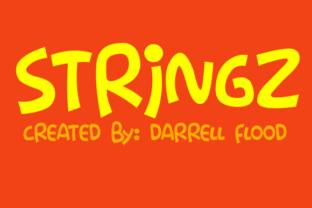
Stringz: A Fun and Expressive Cartoon Style Font for Creative Workflows
Typography is more than just text on a screen or page. It carries tone, personality, and intent. When you need a typeface that breaks away from rigid geometric shapes and sterile uniformity, a font like Stringz offers a refreshing alternative. Created by Darrell Flood, Stringz is a cartoon-style font with deliberately varied letterforms, lively strokes, and an unmistakable hand-drawn feel. It’s designed not just to be read, but to be experienced. For professionals, creators, and marketers who want their projects to communicate energy and approachability, understanding where Stringz fits into a broader design process is key to using it effectively.
This article explores practical ways to integrate Stringz into your work—whether you’re preparing a brand identity, developing educational materials, or adding a playful touch to a marketing campaign. We’ll cover how it interacts with other tools, how to plan for its use, and how to maintain quality and consistency across projects.
Understanding Stringz and Its Place in Your Design Toolkit
Stringz belongs to a category of display fonts that thrive in contexts where personality matters more than pure legibility at small sizes. Its cartoon aesthetic isn’t a random collection of whimsical shapes, but a deliberate system of expressive alternates. Each letter carries its own slight eccentricities—curves that lean differently, terminals that taper unexpectedly, and a warmth that feels human rather than machine-made. This variation is intentional, not accidental. It’s what gives Stringz its charm.
In professional workflows, a font like Stringz is rarely a workhorse text face. You wouldn’t set a long article or a formal report in it. Instead, it excels as a hero element—headlines, pull quotes, logos, posters, social media graphics, and packaging. Recognizing this placement helps you avoid misuse and ensures the font enhances rather than undermines your message. The first step in integrating Stringz is treating it as a specialist in your typographic roster, much like you would a bold script or a geometric sans-serif for specific roles.
Integrating Stringz into Your Creative Process: Before, During, and After
Successful use of any expressive font requires planning. Stringz is no exception. Here’s how to think about it across the phases of a project.
Before You Start: Planning for Personality
When you’re defining the visual direction of a project—whether it’s a children’s book, a playful brand, or an event flyer—ask yourself: Does the tone call for spontaneity and warmth? If the answer is yes, Stringz can become a central part of the mood board. During the planning stage, gather references of other work that uses hand-drawn or cartoon typography. Note how color, layout, and imagery interact with the type. This preparation helps you decide not just if Stringz fits, but how much of the text should use it. Often, pairing Stringz with a clean, neutral sans-serif for body copy yields the best balance—energy where you want it, readability everywhere else.
Also consider file format and licensing. Stringz comes in common font formats (OTF, TTF) that work across most design software. Before starting, verify that the weight and style you need (regular, bold, or other variants) are available for your intended use—commercial or personal. This avoids workflow interruptions later.
During Execution: Composing with Variation
Stringz’s strong suit is its letterform variation. During the design phase, leverage this by composing headlines that feel organic. Instead of typing a heading once and hoping for the best, experiment with alternate characters if the font includes OpenType features. Many cartoon fonts offer stylistic sets, swashes, or contextual alternates. Stringz’s unpredictable shapes can make each instance of a word look slightly different—which is perfect for a logo or a one-off graphic, but requires attention if you need consistent repetition (e.g., for a website header that appears on every page).
When integrating into software like Adobe Illustrator, InDesign, or Canva, take time to kern critical pairs. Cartoon fonts often have exaggerated spacing and overlap zones. Manual kerning ensures that two letters that look great individually don’t collide awkwardly in a word. For instance, a capital “A” followed by a lowercase “r” might need slight adjustment to maintain visual balance. This attention to detail separates a professional implementation from a messy one.
After Completion: Quality Control and Adaptation
Once the design is finalized, review how Stringz performs across different sizes and media. On a large poster, the cartoon details are a feature; at a small size on a mobile screen, they might become distracting or hard to read. Test in real-world contexts. If you’re producing print materials, check how the font renders at the intended scale—you don’t want thin strokes to disappear in offset printing. In digital contexts, verify that web font file sizes are acceptable and that fallback fonts are specified for browsers that may not load Stringz immediately.
After launch, collect feedback. If you’re using Stringz for a client project, ask how the font is perceived by the target audience. Does it align with the brand’s voice? Does it make the content more engaging? This feedback informs future projects and helps you refine your selection criteria.
Working with Stringz Alongside Other Tools, Assets, and Methods
No font exists in isolation. Stringz interacts with the rest of your design system—colors, illustrations, photography, and layout grid. Because of its strong visual character, it often becomes the dominant element. This means other components should support, not compete with, the typography.
- Pairing with complementary fonts: Choose a subdued sans-serif such as Inter, Montserrat, or Lato for body text. The contrast between a calm, readable sans and an expressive cartoon style creates hierarchy without visual noise. Avoid pairing Stringz with another display font unless you have a specific reason—that often leads to cluttered composition.
- Color palette alignment: Stringz works best with bright, saturated colors that echo its playful tone. However, don’t let color distract from the letterforms. Use solid backgrounds or subtle gradients. For black-and-white projects, the font’s line variation already adds enough texture.
- Illustration and iconography: If your project includes hand-drawn illustrations, Stringz will feel right at home. If you’re using stock photography, consider overlaying text on solid color blocks or inside mask shapes to create separation. The goal is to make the font feel like a natural part of the composition, not a sticker placed on top.
- Asset organization: Keep Stringz in a clearly labeled library, either locally or in a shared team asset manager (like Adobe Fonts or a cloud drive). Note the license type and version. This small step saves time during onboarding or when revisiting an old project.
From a process perspective, Stringz integrates well with agile workflows. You can quickly test it in wireframes or mockups using placeholder text, then replace with actual copy after approval. Its expressive nature makes it easy to get stakeholder buy-in because it communicates “fun” immediately—but be prepared to also ground that excitement with practical constraints (readability, scalability).
Practical Implementation Tips for Professionals and Creators
After understanding the strategic placement and integration, the next step is hands-on execution. Here are actionable tips tailored to common scenarios.
- For logo design: Use Stringz as a starting point and then customize. Because of its hand-drawn feel, you can trace over the font to create a unique logotype that isn’t purely digital. This preserves the playful spirit while making the brand mark proprietary.
- For social media graphics: Keep text short. One or two words in Stringz can anchor a thumbnail or Instagram story. Pair with a solid background and a simple emoji or icon. Test readability on mobile preview before scheduling.
- For headlines in educational or children’s content: Stringz is ideal for chapter titles, lesson headings, or call-out boxes. But reserve it for 10–20% of the total text volume to avoid overwhelming readers. Use larger sizes (36pt+) and generous leading (line spacing).
- For product packaging: Stringz adds a handmade, small-batch vibe. Use it for product names, taglines, or flavor labels. Ensure it pairs with the overall package color and material—the font’s curves work well on soft packaging (e.g., pouches) or rounded containers.
Another practical consideration is file delivery. If you’re sending design files to a printer or developer, include the font file (if licensed for transfer) or outline the text. Many print shops prefer outlined artwork to avoid missing font errors. For web developers, provide the font in web formats (WOFF/WOFF2) and include a @font-face snippet. This keeps the implementation smooth for the technical team.
Long-Term Use: Maintaining Consistency and Avoiding Style Fatigue
Trends in design shift, and a cartoon font can feel dated if overused. For long-term use—such as a brand’s identity—periodically reassess how Stringz is performing. Is it still evoking the intended emotion? Has the audience grown accustomed to it, maybe too accustomed? You can rotate its role: use it heavily in seasonal campaigns, then tone it down during more conservative periods. This keeps the font feeling fresh without requiring a full rebrand.
Consistency also means documenting your typographic rules. Create a simple style guide that specifies Stringz’s size, weight, color, and pairing font. Note where it should not be used—for example, in footnotes, legal text, or any text smaller than 18pt. This guide ensures that all team members apply the font consistently, preserving the quality of your output.
Finally, consider how Stringz ages with your project. If the font is part of a website, test it after browser updates or new device releases. For print, archive the final artwork with the font embedded or noted. These small maintenance steps prevent future breakage and extend the useful life of your design systems.
Final Thoughts on Making Stringz Work for You
Stringz is not a font you choose by accident. Its expressive, cartoon-style letterforms demand intentionality. By placing it carefully in your process—planning its role, executing with attention to detail, and reviewing results post-delivery—you can harness its energy without sacrificing clarity. For professionals and creators who value both creativity and practicality, Stringz is a tool that rewards thoughtful integration.
Whether you’re a marketer preparing a campaign that needs to stand out in a crowded feed, an educator making learning materials that spark joy, or a small business owner designing packaging that feels personal, Stringz offers a distinctive voice. Use it where you want to be heard, and support it with strong design fundamentals. That combination is what turns a fun font into a functional asset.